

In 2024, the global economy turned a corner as inflation fell and central banks began to lower interest rates. Consumer confidence, while not exuberant, recovered sufficiently to lead to a rise in eCommerce spending for the first time since the pandemic.
eCommerce turnover in Europe is forecast to hit €958 billion in 2024, up 5% in real terms compared with 2023.
No market in Europe had more consumers making online purchases than the Netherlands. With an estimated market size of €30.5 billion in 2024, Dutch eCommerce sales are estimated to reach €47.5 billion by 2029, growing confidently at a CAGR of 9.31%.
In our annual whitepaper of eCommerce trends, we highlight the developments that will strongly impact the growth and competitive position of wholesalers and brands. Last year was dominated by the emergence of Artificial Intelligence (AI) and this is still top of mind for business leaders as we go into 2025. As the main driver for robotics, IoT, and big data, AI will continue to change eCommerce as businesses shift from piloting to operating AI-based technologies.
AI is transformative across the entire eCommerce value chain, from customer insight to marketing, digital back office, procurement, operational effectiveness, and sales, making it core to the long-term viability of your business.
This is reflected by the strategic spending decisions that eCommerce leaders are making. A recent survey by McKinsey found that almost 20% of eCommerce leaders made AI an absolute priority for the coming year, with roughly a third planning to put more than 10% of their eCommerce budget towards it.
Our first AI-driven trend for next year is hyper-personalization. How well you understand your customers going forward depends almost entirely on how well you leverage AI.
Hyper-personalization is an offshoot of predictive analysis, applied to customer behavior. However, predictive analysis can also be used to improve the performance of your business. This is our second trend for the coming year.
AI reaches into all aspects of eCommerce – whether customer-facing or in the backend of your eCommerce platform. This seamlessness between your channels and your systems is what we call unified commerce, our third main trend.
With Google phasing out third-party cookies next year, zero-party data will become increasingly pivotal. Consumers are not yet fully convinced that AI won’t break ethical and privacy boundaries so we see data and privacy protection as a big trend for next year, our fourth.
The largest leaps forward in personalization and predictive analysis count for little if your customers are experiencing friction during checkout. So our fifth and final major trend for 2025 is enhanced cross-border payment options.
We round up with several developments we highlighted last year but which are still relevant. Some trends never go out of style; sustainability, mobile commerce, and Augmented and Virtual Reality remain building blocks for competitive advantage in eCommerce.
Personalization works. Amazon generates up to 35% of its sales by recommending products and services based on our browsing and purchase histories.
This didn’t happen overnight. Some of us remember a time when Amazon’s personalized recommendations were hit-and-miss, and often a distraction, but as technology advanced, the digital giant got a lot better at it.
Hyper-personalization is the next leap forward.
AI and Machine Learning can take personalization to the next level. They process data at unprecedented scales and speeds, enabling real-time customer service through AI-driven chatbots. AI enhances content creation and personalization, offering benefits such as:
In a must-read thought piece, Forbes describes the evolution of eCommerce towards a hyper-personalized environment where goods, brands, and people are fluidly interconnected – an AI-driven world that Forbes refers to as eCommerce 3.0.
eCommerce 1.0 functioned in a market where people were looking for goods. First movers such as Amazon and Alibaba began to experiment with personalization, but this was a slow process. Up until a few years ago, 80% of online purchases in China were search-based, with just 20% the result of an algorithmic recommendation. These figures are now reversed because of advances in technology, turbo-charged by AI. What we watch on Netflix is 80%-determined by the suggestions it feeds us.
This is the evolution towards eCommerce 2.0, in which goods are looking for people.
For years, marketers interpreted their customer base through the invention of personas, which they targeted with segment-based campaigns and offers. The emergence of AI means that eventually these personas will be replaced by the real thing: you – the living, breathing, and digitally engaged consumer. eCommerce platforms are not just looking at past purchases or browsing history, but – increasingly – at real-time interactions and – eventually – at social media data to create hyper-personalized customer profiles and pinpoint accurate recommendations.
What will that look like?
A travel website can combine real-time browsing data with past preferences or search terms to offer flights and hotels. Sports retailers might be able to recover data from the fitness trackers of their customers, enabling them to send out highly tailored and useful recommendations based on exercise targets. An electronics retailer can offer faster shipping options or extended return windows in real-time based on usual requirements, the number of products ordered, and delivery location.
In this way, eCommerce experiences begin to approximate a negotiation in which the digital seller – i.e. the eCommerce site – is armed with infinitely more data and information than the traditional sales rep.
This shift from eCommerce 2.0 to 3.0 – as Forbes terms it – is not straightforward.
Among the most immediate challenges are data security and privacy concerns. Technologically, businesses must have the right data and analytics infrastructure in place. A centralized customer data platform is indispensable. To get started, brands and wholesalers need to identify key customer data points, invest in marketing automation, and promote a company-wide culture of customer-centricity. Your employees should understand how collecting customer data from various sources works and why unifying it is essential for actionable insight and relevant personalization.
The expectations around AI are high, and brands and wholesalers may feel pressured to deliver transformative change quickly. This is unrealistic. Businesses everywhere are setting or resetting expectations, prioritizing investments, and looking for the easiest wins in AI.
Predictive analysis is one of them.
Predictive analytics in eCommerce is the use of current and historical data in combination with advanced algorithms to forecast future trends and behaviors. It helps businesses anticipate customer needs, optimize supply chain operations, and leave guesswork out of important decisions.
We already explored how AI powers hyper-personalization in eCommerce. In this section, we look at how it can transform the quality of your operational and business decisions.
Let’s look at some of the use cases of predictive analytics:
AI also allows you to build predictive models to resolve problems common to eCommerce operations. Some examples include:
As digital channels multiplied, businesses had to show up on all or most of them and implement a multichannel strategy. It turned out that consumers adapted very rapidly to this proliferation of touchpoints, and moved rapidly and frequently from one to another in their research or purchasing journeys. If your messaging across these channels was inconsistent your customers experienced unhelpful friction and potentially moved to a rival brand or wholesaler. Omnichannel was born out of the necessity to join the dots, fill the gaps, and present the consumer with cogent and consistent information across all channels.
Omnichannel is not so easy to implement but B2B and B2C organizations have accepted they have to make it a reality. A seminal paper by McKinsey, published at the height of the Covid crisis, recognized that omnichannel had permanently altered eCommerce.
Omnichannel is customer-centric but not necessarily system-centric because the backend technologies that power your channels and the seamlessness between them are not vertically integrated.
Unified commerce completes the journey of omnichannel by connecting all parts of your business with all customer channels. The graphic below illustrates the simple but radical difference between omnichannel and unified commerce very succinctly.
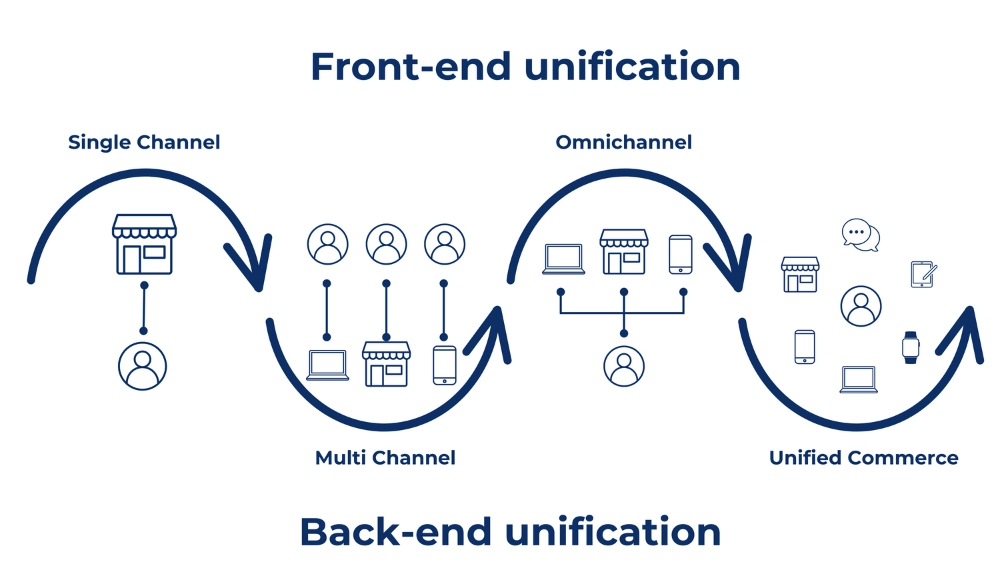
A unified commerce approach aims to connect the front and backend systems of all your channels through one platform. In omnichannel, there is always a risk that things fall through the cracks of siloed systems; in unified commerce every data point is shared between every part of the business, giving you a real-time view of your payments, customers, inventory management, and more.
The unified commerce platform is built on a single technology stack that handles everything from omnichannel marketing to order fulfillment. At their end, consumers experience seamless shopping even as they move from touchpoint to touchpoint.
Unified commerce offers several significant benefits for businesses. Here are some key advantages:
Omnichannel and unified commerce operate from the same premise: that whatever supports the customer in his or her purchasing trajectory will ultimately enhance the business, increasing sales and enhancing loyalty.Transitioning from omnichannel to unified commerce is a significant step for companies, requiring strategic planning and technological investment.
Below we give a high-level, step-by-step outline of how companies can make this transition:
These are the first steps towards building unified customer profiles and optimize inventory management and fulfilment – the big prizes of unified commerce.
However, most brands and wholesalers will have other priorities for 2025 – notably around implementing the first wave of use cases for AI in eCommerce. For them, unified commerce is an ideal, an aspiration, rather than a project for which they have the budget or the bandwidth. There are other trends that demand more immediate attention, such as the collection of zero-party data or the removal of pain points in the final hurdle of any transaction: payment.
The value of cross-border eCommerce payments is expected to surge from $1.6 trillion in 2023 to more than $3.3 trillion in 2028 – a third of total anticipated global revenues.
This increase is driven in part by the rapid expansion of marketplaces, especially in developing markets where non-traditional methods of payments such as mobile money have long been popular.
In theory, your eCommerce shop is open to anyone with an internet connection, provided you have distribution in that market and that you offer the culturally prevalent method of payment.
One of the surprising outcomes of the euro project is just how deeply engrained these cultural preferences are.
For example in Germany, PayPal is the most popular instrument for B2C transactions while in neighboring Poland and Austria, direct bank transfers are still commonly used.
In many markets, consumers prefer a “home-grown” payment mechanism to traditional banking card infrastructures such as Visa or Mastercard. This is especially true in the Netherlands where more than 70% of digital payments are transacted on the iDEAL platform.
Other European markets operate similar platforms. Examples include EPS in Austria, P24 in Poland, Multibanco in Portugal, and MyBank in Italy.
The euro has of course greatly facilitated frictionless trade across most EU borders, but pain points remain for brands and wholesalers that want to ramp up exports, even when there is no currency conversion involved.
Not all member states use the euro, and there are non-EU markets such as the United Kingdom and Turkey where your customers expect prices in their local currencies, even in real-time if you use dynamic pricing to respond to demand.
The most popular method of payment after debit and credit cards and digital wallets such as ApplePay, PayPal, and Google Wallet is Open Banking.
Open Banking relies on banks sharing customer data with fintech firms to enable direct account-to-account (A2A) payments.
Open Banking integration in eCommerce offers many advantages:
Open Banking was initially met with resistance from traditional financial institutions but EU legislation under its Second Payments Services Directive (PSD2) requires banks to share their data, making Europe a leader in A2A adoption.
This legislation is being revised, and the European Commission has submitted proposals for PSD3 which seeks to ensure greater harmonization of the rules across the EU, further develop a level playing field for payment providers, and introduce improvements in customer and fraud protection.
eCommerce business is global by its very nature. For brands and wholesales strategizing to expand in different markets, payment structures are a prime consideration, even within the eurozone.
The proliferation of Large Language Models and the power of AI to create lifelike parallel worlds is amplifying privacy and ethical concerns about data. Governments have generally been in lockstep with the wider public over this and GDPR was a watershed moment in data protection.
The use of cookies has been monitored for several years but it is doubtful if many consumers know exactly what data they are giving up (or how much privacy they are sacrificing) when they tick the “All cookies” consent button. Cookies are still too much of a backdoor way of collecting data and in the course of 2025, Google cookies will be abolished altogether.
This has been a long time coming and marketers have had ample time to adjust and come up with alternative strategies. This was predicted back in 2020 when Forrester coined the term “zero-party data” to denote the information that consumers intentionally and proactively surrender to brands.
How do you persuade consumers to give up key data such as their emails? By making it fun through quizzes, games, and questionnaires, or by offering something in return such as a newsletter, interesting research, or a ROI calculator.
Personal details pave the way for personalization, and this benefits eCommerce businesses as well as consumers who will receive relevant product offers and a customer experience that is in sync with their needs and priorities.
We should look at the advantages of zero-party data in more detail. These are the most important ones:
Martech and adtech vendors are emphasizing data acquisition scenarios in their strategies to help eCommerce brands and wholesalers obtain more zero-party data.
Of course, all this hard work will come to nothing if your customers do not trust you – for whatever reason. Trust is a higher threshold with zero-party data because customers are deciding to part with their data and privacy, and not passively subject to it as with cookies and browsing behavior.
Your zero-party data strategy must go hand in hand with a privacy-first policy.
Privacy-first is an approach to both business and technology that prioritizes user privacy from the outset. Done effectively, it should inform everything from how products and systems are designed, the way they get built, and even how you communicate and interact with customers. It may mean data minimization — minimizing the amount of data you collect — but it should also build trust through greater transparency.
Privacy-first is not just about ticking compliance boxes; it is about recognizing that privacy is key to building strong customer relationships.
In creating a zero-party data strategy businesses have to ask themselves a lot of fundamental questions and answer them succinctly and unambiguously to their customers. Questions such as:
To collect personal information, brands also need to put their policies in a prominent location on their site – not as legal small print but designed with the same panache and thoughtfulness as your product pages.
Respect is part of your brand, and if you convince the customer of this, they will be open to sharing important data with you.
Augmented Reality (AR) is the integration of digital information with the user’s environment in real time. Virtual Reality (VR) replaces the environment with entirely digital content.
VR requires hardware such as Apple Vision Pro and Meta Quest which for the time being are niche products. Apple is pitching its headset to manufacturers with VR use cases in production or maintenance but adoption so far has been very slow. Use cases in eCommerce offer augmented rather than virtual experiences allowing shoppers to try clothes, accessories, and cosmetics by projecting the items on themselves or their virtual avatars.
For now, the main benefit of VR headsets is that they offer a better AR experience which has been around for a long time.
As far back as 2019, Coolblue launched AR capabilities to “place” television sets in living rooms so that consumers would not order the wrong size which accounted for the bulk of returns.
Curbing returns is one advantage of AR as well as much greater engagement and conversion. A recent survey reported that 55% of consumers believe AR makes the shopping experience more exciting, while 40% are willing to pay more for a product if they can use AR to test it out first.
The distinction between the physical and digital worlds is blurring – or such is the mission of SEAMM, the first “phytigal” fashion marketplace where every item exists as a tangible, physical piece and a virtual, digital twin.
While online shopping seemed to spell the end of brick-and-mortar stores, VR will one day offer us fully immersive virtual stores, where customers can walk through digital environments, browse products, and make purchases – just as you would in a “real” shop.
We are used to orchestrating our lives through our mobile devices – and this goes for small decisions such as ordering takeout, or for “serious” activities such as buying shares, or placing large B2B orders. More than 70% of B2B decision makers are millennials for whom mobile devices are a natural extension of themselves.
Conditioned by their B2C journeys, B2B buyers are expecting the same or better experiences from brands and wholesalers – and a digital experience is incomplete without an app which also unlocks a path to social media. Gone are the days when B2B only engaged with LinkedIn or Facebook; many brands are flocking to Instagram and TikTok to spread their message.
The graphic below is a snapshot of why and how B2B is using mobile eCommerce in parallel with the traditional website.
Why B2B mobile commerce matters
Although a firm timetable for the implementation of the EU Digital Product Passport has not been published, it is expected to come into force in 2026 and businesses are preparing for it already, especially in the textiles and electrical goods sectors.
The typical consumer shares the outrage of the European Commission over the 5m tons of clothes thrown away every year – about 12kg a person. Equally unacceptable, in the Commission’s view, is the extent of fake claims about sustainability, with over half of green claims containing “vague, misleading, or unsubstantiated information”.
Just as GDPR was a milestone achievement for data security, the Commission is hoping that the EU Digital Product Passport (DPP) will mark a transformative moment for sustainability.
A DPP is a digital record with comprehensive information about a product and its entire supply chain. It contains important data, from the origin of the product and the materials used to its environmental impact and disposal recommendations.
The data within a digital product passport solution can vary, but it typically includes product lifecycle and value chain information, such as:
The DPP will allow consumers to make eco-conscious choices. It offers businesses the opportunity to optimize the supply chain, reduce environmental impact, and enhance brand reputation.
Consumers want to buy sustainably - and Amazon would not be Amazon if it did not capitalize on this sentiment. Its Sustainability Accelerator is sponsoring 15 start-ups across Europe. They include the French all-in-one home repair specialists, Spareka, which sources spare parts for home appliances, ships these to the customer’s door, and has on-demand specialists to video-call the customer and walk them through the repair process. Another initiative supported by Amazon is Re-Zip from Denmark, which rewards customers for returning reusable packaging, often in the form of a voucher for the webshop from which they ordered.
Sustainability is not a box-ticking exercise or a badge of good behavior; it is as much part of your brand as your products, your messaging, and your eCommerce customer experience.
Artificial Intelligence was a trend for 2024 and will continue to dominate strategic investment and marketing decisions for the remainder of the decade.
Not only for the eCommerce arm of brands and wholesalers. Education, healthcare, construction, professional services, manufacturing, logistics, software engineering – there is not a corner of the global economy that will not in time be changed utterly by AI.
Changed for the better. McKinsey estimates that GenAI could add between $2.6 and $4.4 trillion annually to global output, as much or comfortably more than the GNP of the United Kingdom which hit almost $3.3 trillion in 2023.
Focusing on customer operation, McKinsey cites the example of a company with 5,000 customer service agents, where the application of GenAI increased issue resolution by 14% an hour and reduced the time spent handling an issue by 9%. It also reduced agent attrition and requests to speak to a manager by a quarter.
In a separate and very recent study, McKinsey estimates that AI adoption across Europe lags behind the US by 45% to 70% – but that the opportunities are vast, potentially adding $575 trillion to the economies of Western Europe by 2030.
As we saw, brands and wholesalers can leverage AI in many different ways to boost the productivity of their eCommerce investments but they will also profit from the overall wealth it is set to create.
The AI “feel-good” factor is not quite there yet as businesses are still recovering from a period of runaway inflation, and are anxious about the geopolitical backdrop in Eastern Europe and the Middle East.
Brands and wholesalers have to take the long view and position themselves competitively when it comes to AI adoption.
AI is not a trend, no more than the internet was a trend at the turn of the millennium, or the cloud in 2010, when Microsoft launched Azure.
It is simply the journey we are on – next year and beyond.
We wish you all a happy, healthy, and eCommerce prosperous 2025.
 EN
EN
 German
 Dutch
Dutch
