

The rise of AI is evident in virtually all facets of marketing – including the email marketing strategies of eCommerce companies. In this article, four eCommerce specialists share their insights following a discussion at the Webwinkel Vakdagen 2025. They answer the question of what the future of email marketing looks like and what role AI plays in it for the eCommerce manager.
The key takeaway from the conversation: the use of AI is never a goal in itself. This also applies to B2B email marketing. It is merely one of the tools within a data-driven marketing strategy. Therefore, every eCommerce manager must first determine which specific problem AI should solve. Without concrete use cases, it will be difficult to achieve a return on the use of AI.

During the Webwinkel Vakdagen 2025, four eCommerce experts discussed the future of email marketing in B2B eCommerce and the role of AI. Dennis Zuurhout (CloudSuite) spoke with Lucas Freriks (Spotler), Sven van der Roest (CloudSuite), and Mick Lodder (Mandrino) about how AI can contribute to personalization, recognizing behavioral patterns, and setting up automated marketing flows.
Listen to the E-commerce Xplored podcast
Together, they explored predictive and generative AI, customer segmentation, retention, and how data and AI models can help optimize the customer journey. This article is inspired by that conversation and can be revisited in the E-commerce Xplored podcast series.
The extent to which an eCommerce manager uses AI largely depends on the scale and digital maturity of the organization. Lucas Freriks states: “If you are a simple dropshipper with a limited product range, you might use ChatGPT to support your content, but that’s about it.” In larger companies within B2B eCommerce, we see eCommerce managers increasingly using AI structurally as part of their email automation and personalization strategy. Still, Freriks remains realistic: “Don’t get blinded by all the possibilities and always verify the outcomes of your AI experiments. Blindly trusting AI is not advisable.”

Targeted marketing, smarter budget allocation, reduced churn, and more personalized customer interactions are all within reach with AI. Especially the possibilities of predictive AI are highly promising within data-driven marketing. Predictive models provide accurate insights into which type of customer is likely to purchase a specific product at a particular moment. This allows you to optimize email campaigns based on expected buying behavior within the customer journey. This not only increases relevance but also strengthens customer retention through targeted loyalty campaigns and optimizes your ROI. Precisely because AI offers such a broad range of possibilities, Freriks emphasizes the importance of clear objectives: “Without clear use cases, it won’t work.”
Moreover, AI offers valuable insights into customer segments that are less likely to convert. This enables you to set up proactive campaigns to win back dropouts or allocate ad spend more efficiently. Email marketing plays an important role in this, as it can perfectly align with the analyses and predictions generated by AI.
According to Mick Lodder, personalization is essential. AI enhances this by recognizing patterns in data from multiple sources. This allows you to build lookalike profiles that drive higher conversion.
In addition, AI improves your workflow through smarter analytics and better segmentation. Entire automation flows can even be largely pre-modeled with AI, leaving the marketer to only fill the flow with the right content.
Mick also recommends visiting the website There's An AI For That® - Browse AI Tools For Any Task.
This site already lists tens of thousands of AI applications.
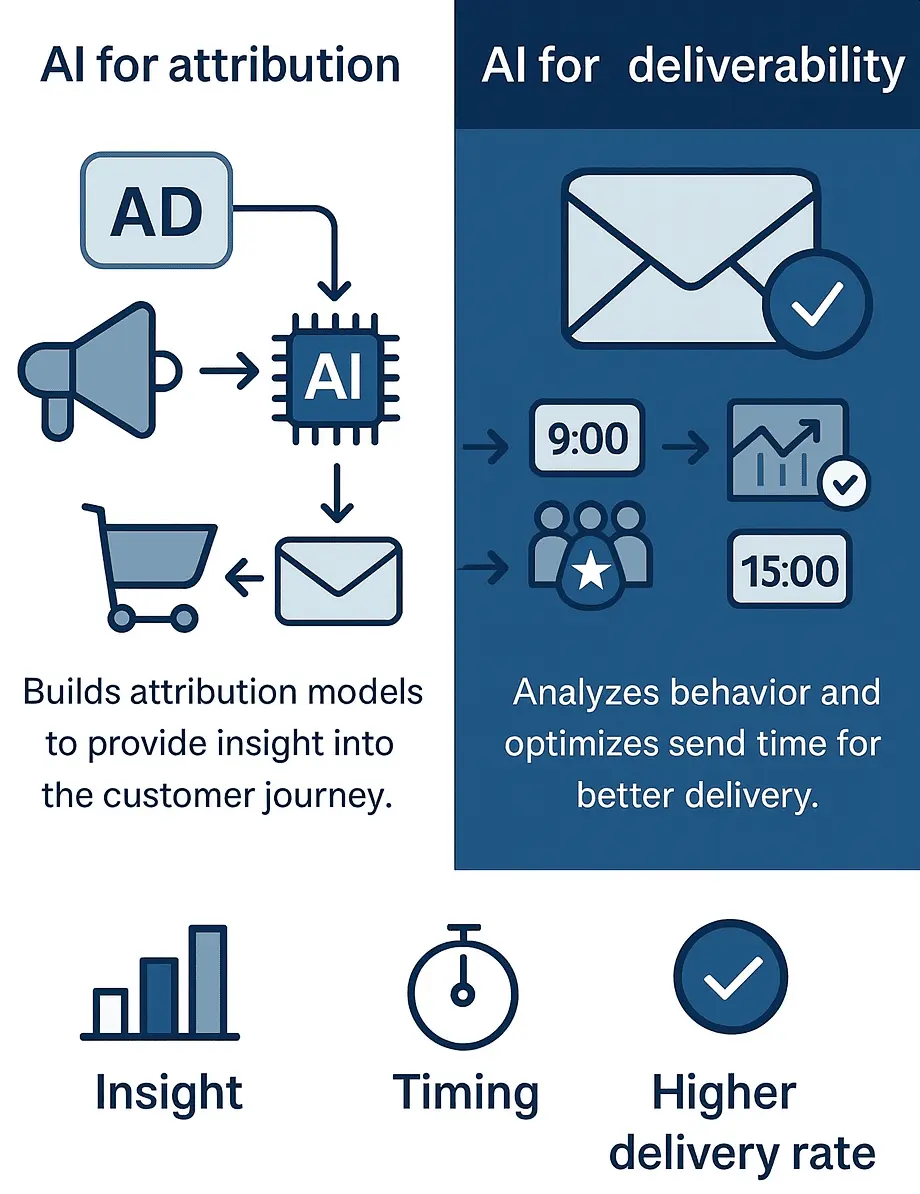
According to Sven van der Roest, AI plays an increasingly important role in solving attribution questions within B2B eCommerce. “Imagine a customer clicks on an ad, later returns organically, fills a shopping cart, and then receives an email that ultimately leads to conversion. It wouldn’t be fair to say that only the first ad was responsible. There are multiple touchpoints that together form the customer journey.” AI helps build attribution models that make this entire route transparent. As a result, the contribution of email marketing becomes much more measurable, enabling data-driven decisions about your channel strategy.
In addition to attribution, AI also contributes to better email deliverability. By sending emails at the right time, you can prevent them from being marked as spam or going unnoticed. AI can analyze behavioral patterns and determine whether an automated email or a personal follow-up is most effective. If AI decides, based on predictive models, that an email will deliver the best result, a relevant message is sent immediately – exactly when the chance of interaction is highest.
Sven and Mick Lodder emphasize that AI is also valuable when sending fragmented bulk campaigns. By spreading the same campaign over multiple time slots, you can avoid overwhelming recipients and increase the chances of successful delivery. This technique doesn’t necessarily require AI, but AI helps determine the best follow-up action based on behavior.
For example: a customer visits your webshop at 11:00 p.m. An email with a relevant offer sent immediately afterward is likely more effective than one delivered the next morning via a nightly data sync. And sometimes, a sales call is more effective than an email. AI can predict which touchpoint and channel offer the highest chance of conversion based on observed behavior.
Emails that align with the behavior and expectations of the recipient lead to more interaction, a better reputation, and ultimately a higher delivery rate – an essential component of a successful, data-driven email strategy.
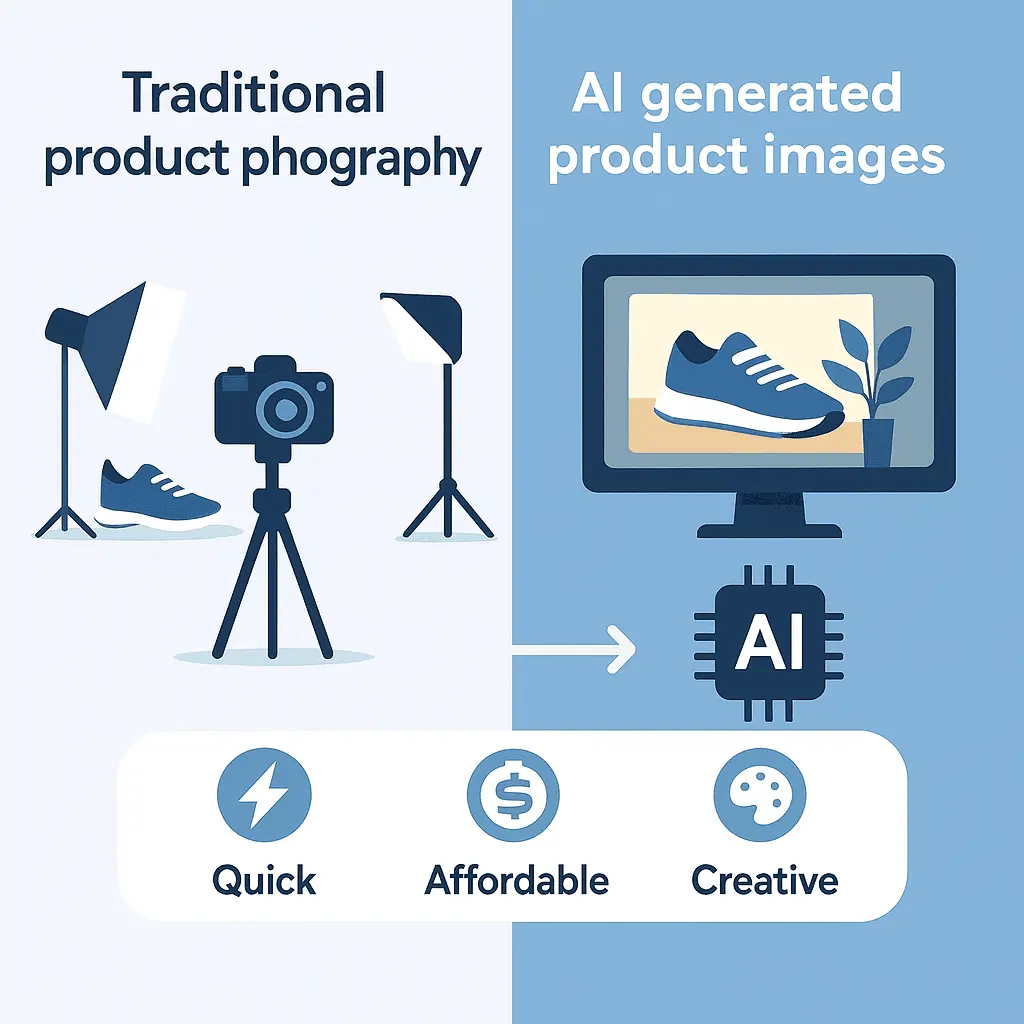
For many SMEs, generating product images for email campaigns is a challenge. Professional studio photography is expensive and time-consuming. According to Lucas Freriks, AI is truly a game changer in this area – even the “holy grail” of email marketing for this audience. With the help of AI tools, you can create high-quality product visuals in a suitable setting, without a physical photoshoot. In addition, AI offers inspiration for coming up with new visual concepts and styles. And the output? It is often stunningly good.
The enthusiasm about AI raises an important question for Dennis Zuurhout of CloudSuite: “Will this make customers too self-sufficient? Will organizations like Mandrino, Spotler, and CloudSuite still be needed in the future?”
Lucas Freriks puts this into perspective: “Self-sufficiency is actually our goal. Spotler is a software company and provides generic tools. We clearly show what customers can do with our software. If they want to expand their applications, the responsibility lies with them. But that doesn’t mean customization is always easy. That’s why our partner network is essential – and why we work closely with companies like CloudSuite and Mandrino.”
CloudSuite helps eCommerce managers offer the optimal shopping experience and remain flexible to seize market opportunities. Mandrino plays a crucial role in data integration, for example when a client needs specific integrations with existing systems. Together, all parties ensure a workable and scalable solution.
AI is rapidly changing the playing field – also within B2B eCommerce and email marketing. But anyone who thinks traditional marketing is ‘dead’ is missing the point. AI is a powerful tool, but never a goal in itself. Always start with a clear marketing objective and then explore how AI can contribute to it.
Whether it’s personalization, predictive analytics, creating visuals, or optimizing campaigns: AI offers huge opportunities. But translating this into concrete impact requires knowledge, strategy, and collaboration. Chances are that CloudSuite, Spotler, and Mandrino can provide excellent support in achieving this.
Special thanks to Hendrik Westerhuis, Senior Content Marketer at Spotler, for his valuable contribution to the creation of this article.

 EN
EN
 German
 Dutch
Dutch
