EN
EN
 German
 Dutch
Dutch

Shopify B2B now available on all plans: What’s the real impact for wholesalers and producers?
10-04-2026



Imagine: today you process your B2B orders via email, manage customer discounts in a spreadsheet, and send invoices manually. If so, this news from Shopify is highly relevant. They have opened up a large portion of their B2B functionality to all plans, including the $39 per month Basic plan. Company accounts, price catalogs, payment terms, PO numbers: barriers that were previously only surmountable via Shopify Plus are now much lower.
But suppose you are already a step further. You have a hundred customers, each with their own purchasing agreements, your sales reps need to be able to order on behalf of customers, and your ERP is the heart of your operation. Then the more relevant question is not what Shopify is adding now, but where the platform stops.
This article provides an honest answer to that question.
The rollout includes company accounts and locations with role-based permissions, B2B price catalogs via Markets (up to three), quantity rules and price breaks, payment terms with reminders, a workflow from draft order to invoice, easy reordering with PO numbers, the Trade theme as a B2B storefront, and Shopify Flow with B2B objects for automation.
For a company taking its first step toward structured digital order processing, this removes a real barrier. That is no small feat. And it is a clear signal that the market recognizes that B2B e-commerce has been underserved for a long time.
But growing means that the threshold is not the finish line.
The features that define a mature B2B operation are not in this announcement. And that is exactly the point where it becomes concrete for wholesalers and manufacturers.
This is the most fundamental difference. Shopify was built as a commerce platform to which B2B functionality was added. CloudSuite was built from the operational logic of wholesalers and manufacturers, with direct ERP integration as the starting point.
Orders flow through the ERP. Inventory management, customer data, price agreements: everything is synchronized without intermediate layers. That is not a feature. That is architecture.
But there is another layer beneath this difference that is often overlooked. In B2B, one hundred percent of orders never go through the commerce platform. Some of your customers call, send an email, work via EDI, or place an order through the sales force. Shopify only shows in the customer account what came in through Shopify. Offline orders simply do not exist there.
For a customer who wants to view their full order history, that is a major missing piece. Not as an edge case, but as a daily reality in B2B. Because the complete order history is the foundation for everything that follows: creating order lists based on what you actually buy, not just what you ordered online. Viewing invoice information from all channels in one place. Product recommendations that are accurate because they are based on the real buying pattern, not a partial view.
CloudSuite synchronizes the complete order history from the ERP, including offline orders. The customer sees in their account what they have actually ordered, regardless of the channel through which the order arrived. This makes personalization meaningful and reordering practical. And it prevents your B2B portal from telling a half-truth.
On standard plans, Shopify allows a maximum of three active price catalogs, assigned at the market level and not per individual customer. For a wholesaler with dozens of customers on varying purchasing agreements, that is a ceiling reached very quickly. Unlimited catalogs and direct linking to customer accounts remain reserved for Shopify Plus, which starts at $2,300 per month.
CloudSuite operates without this ceiling. Each customer gets the price agreements associated with the relationship: contract prices, volume discounts, customer groups, directly linked to the account without a detour through Markets.
Shopify has no native quoting module. If you want to manage quote requests, price negotiations, and approval workflows, you need an external application or custom development.
CloudSuite has a built-in quoting module that handles the entire workflow: request, negotiation, approval, and conversion to order, in one environment, without intermediate steps.
Buyers ordering large volumes do not work through a product catalog. They upload a file with part numbers and quantities. That is how they work, and that is how they have always worked.
CloudSuite processes this as standard, including CSV upload and bulk ordering. Shopify does not offer this natively.
Trade accounts require verification. You want to know who you are accepting as a business customer before they gain access to your B2B environment.
CloudSuite offers a fully configurable registration process with custom fields, approval steps, and automatic notifications. Shopify's company account settings do not offer this at the same level.
CloudSuite automatically generates invoices that buyers can view and download directly from their account. Customizable content, payment terms, support for your own branding—all without an external invoice app.
Shopify does not offer this built-in.
The comparison below provides an overview of what is available on Shopify's standard plans versus CloudSuite. Some additional features are available via Shopify Plus (starting at $2,300 per month).
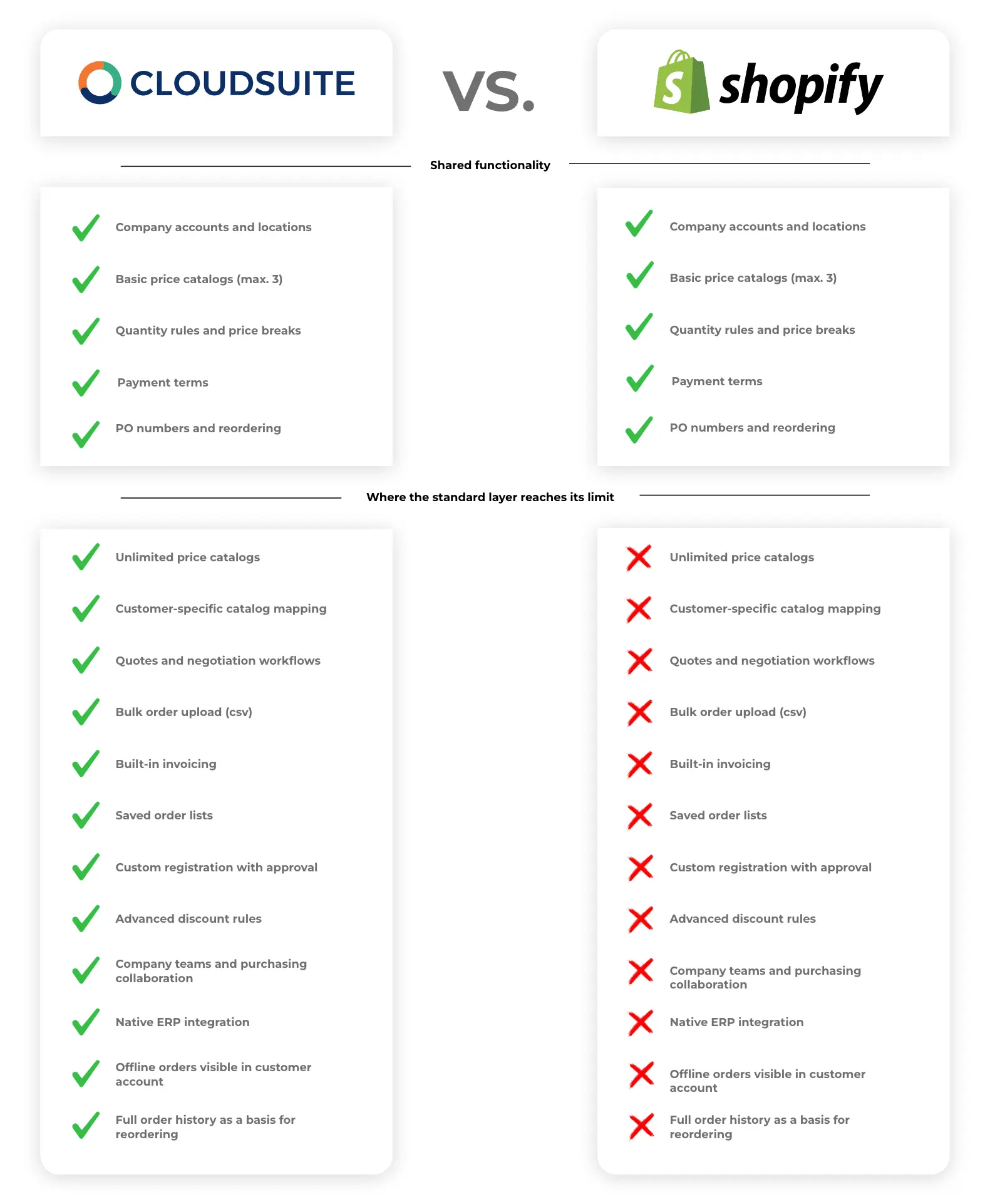
The announcement is bigger than the reality for those who take B2B seriously.
Three price catalogs at the market level, not per individual customer. For companies with a limited and homogeneous customer base, this might suffice. However, for businesses with differentiated pricing structures—which is the norm in wholesale—this ceiling is reached quickly.
Partial payments and deposits are completely missing. ACH payments are limited to the United States. For European B2B companies, these are limitations that must be addressed through workarounds.
And then there is the price point. Shopify Plus starts at $2,300 per month. The choice between what the standard plans offer and what lies behind that price tag is a deciding factor for many companies when choosing a platform. It is a choice you should make consciously upfront, rather than in hindsight.
Shopify charges transaction fees on orders processed outside of Shopify Payments. For B2B companies with high average order values, this can amount to a substantial annual sum that is rarely included in the initial platform comparison.
CloudSuite customers process payments through their ERP, accounting integration, or offline. CloudSuite does not charge transaction fees on orders. It is a calculation you are better off making before choosing a platform rather than after.
Making Shopify B2B more accessible is good for the market. More companies will take digital B2B order processing seriously. A portion of them will find the native tools sufficient, and that is perfectly fine.
But there is a category of companies for whom the basic layer was never the finish line. Wholesalers with complex pricing structures. Manufacturers for whom ERP integration is not optional. Brand manufacturers who want their distribution network to reorder without manual intervention. For these companies, the choice of platform is not a matter of entry price, but of architecture.
And that architecture determines how much freedom you have as your business grows.
CloudSuite works with wholesalers and production companies in the Benelux that want to scale their B2B channel—not as an experiment, but as a mature commercial channel.
The question is which platform will still be able to keep up three years from now.

Want to know how unified commerce can take your organization to the next level? Get in touch with CloudSuite. We’ll help you evolve from disconnected systems to one powerful, unified platform.