EN
EN
 German
 Dutch
Dutch

Agentic Commerce: what happens when your customer no longer places orders themselves?
18-05-2026
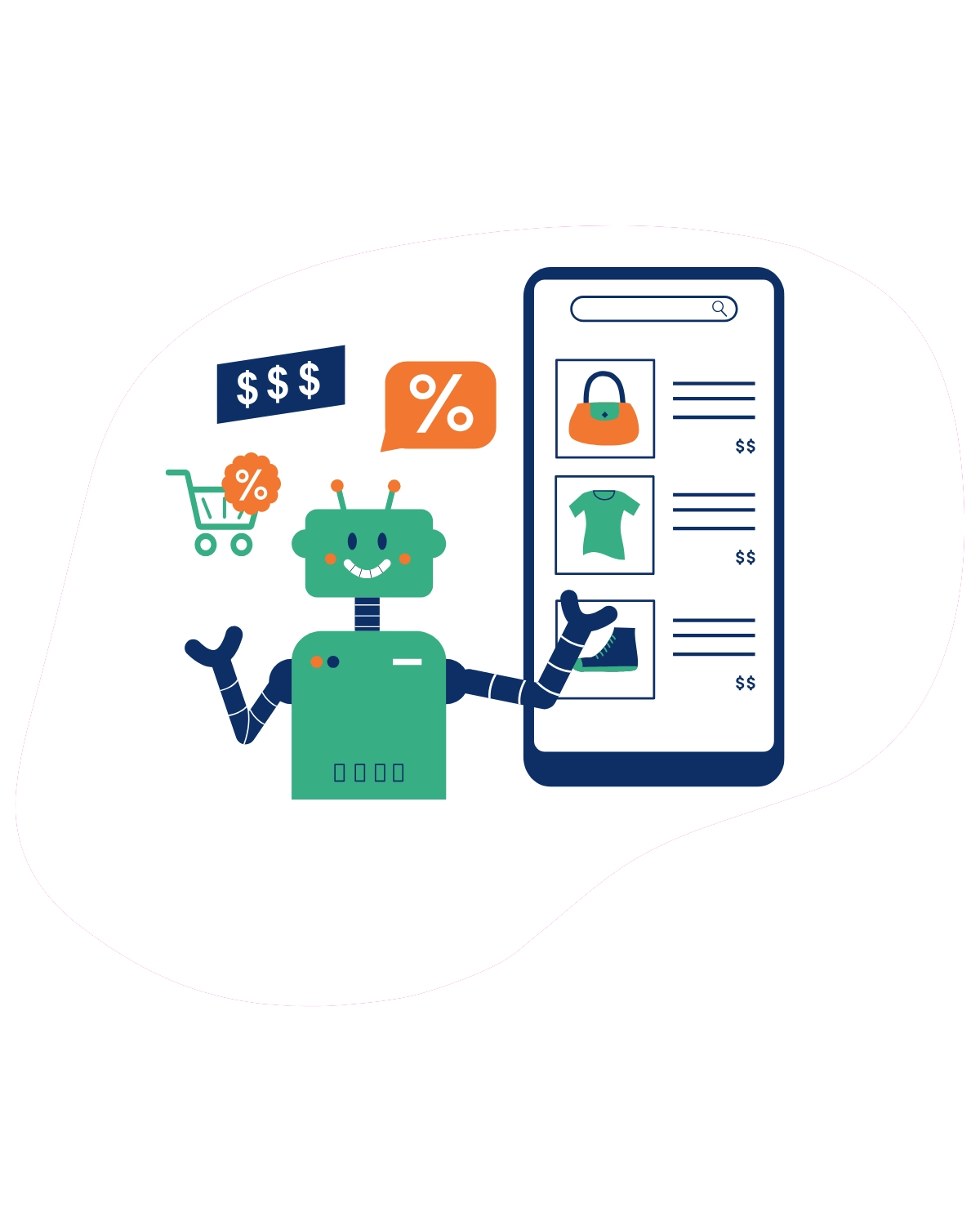


Over the past few years, most wholesalers have invested heavily in their digital ordering environments. Better search functionality, faster checkout processes, smarter product pages. Logical steps. But what if, in two or three years, the customer no longer navigates through that environment at all? What if an AI agent takes over, comparing, deciding, and ordering on behalf of the customer without any human involvement?
That is not a distant future. It is the direction Agentic Commerce is heading in. And for wholesalers currently focused on creating a well optimized webshop front end, it is worth understanding what is driving this movement behind the scenes.
From assistant to actor
Artificial intelligence has been part of eCommerce for years: product recommendations, chatbots, personalized search results. But those applications are passive. They support the person who ultimately makes the final decision.
Agentic Commerce is fundamentally different. Here, an AI agent acts independently. The agent receives a goal such as “make sure we never fall below the safety stock level for this product” or “find the best supplier for this raw material within our preferred supplier network” and then carries out the necessary steps. Searching, comparing, negotiating, ordering. All without a buyer clicking a button.
The technological building blocks already exist: large language models with reasoning and planning capabilities, standardized API infrastructures, and integrations between ERP systems and external platforms. What is still missing is scale and trust. But that is changing rapidly.
To understand what this means in practice, it helps to look at a concrete example. Imagine a chef who places weekly orders with a food wholesaler. Today, they log in, browse categories, and build an order based on what they think they need. Tomorrow, an AI agent will do that for them.
The chef tells the agent they want to prepare a Mediterranean menu next week for around twenty guests. The agent suggests suitable dishes, immediately translates those suggestions into the required ingredients, and then matches them to the available products in the wholesaler’s catalog. Everything is ready in the shopping cart. The chef reviews the order, adjusts it if necessary, and confirms it.
But the agent can go even further. If the chef wants to know what they ordered last month or wants to partially repeat a previous order, the agent consults the order history and prepares the desired products instantly, without the customer having to navigate pages or look up order codes.
This is not a future scenario limited to the consumer market. This is exactly the type of interaction that will emerge in B2B, among wholesalers in food, technical supplies, construction materials, and virtually every other segment. The customer communicates in natural language, and the agent handles the execution.
We have been hearing about this trend in consumer markets for some time. But in B2B, the impact is potentially even greater because purchasing processes are more complex, repetitive, and well suited for automation.
A manufacturing company that purchases the same raw materials every month benefits from an agent that monitors and executes that process. A wholesaler acting as an intermediary wants to reorder efficiently from suppliers. A brand manufacturer managing its distribution network can use agents to automate inventory decisions.
In each of these scenarios, the role of the human buyer changes. They do not disappear, but shift from executor to supervisor. The agent acts, while the buyer defines the framework and intervenes in exceptional situations.
For you as a supplier or wholesaler, this means that you will increasingly interact not with a human visiting your webshop, but with an automated system trying to complete a transaction on behalf of that customer.
The question wholesalers should ask themselves now is not whether Agentic Commerce is relevant. The real question is: are we prepared when customers start using it?
That requires a different perspective on several core foundations.
Product data is no longer only for humans. An AI agent comparing products on behalf of a customer does not read product descriptions for inspiration. It processes structured data: product codes, specifications, availability statuses, pricing rules, and delivery times. If that data is inconsistent, incomplete, or stored in a format that is difficult for machines to process, you will be excluded. Not because a person finds it unclear, but because an algorithm cannot interpret it properly.
API accessibility becomes a basic expectation. Wholesalers still relying primarily on browser interfaces with limited or no API access create friction for automated integrations. Customers working with agent driven procurement will seek suppliers that connect seamlessly to their systems. The webshop remains relevant for human users, but the API becomes the gateway for machines.
Pricing transparency and commercial conditions will face greater scrutiny. Human buyers weigh factors that are difficult to quantify: trust in the supplier, historical relationships, service quality. An AI agent evaluates what can be measured: price, delivery times, availability, reviews, and deviation history. Suppliers that score strongly on those parameters will be selected more quickly. Those with unclear or outdated conditions will be ignored.
The customer journey is no longer linear. Traditional B2B commerce assumes a customer orients themselves, compares suppliers, contacts sales, and places an order. In a world of agents, a customer can move directly to a transaction through an automated pipeline. Without involvement from an account manager. That requires processes capable of handling autonomous transactions without manual intervention on the supplier side.
One conclusion becomes clear from all of this: the quality of your product data becomes a first order competitive factor.
This principle is not new. In B2B eCommerce, we have talked for years about the importance of complete, reliable, and structured product information. But Agentic Commerce raises the stakes. Previously, poor data resulted in a poor customer experience. In a world of automated procurement, poor data results in missed transactions without you ever hearing about them.
Wholesalers and manufacturing companies that take product information management seriously, have properly implemented a PIM system, and consistently distribute their data across multiple channels are building a technical foundation aligned with the direction of the market. Companies that still do not have this in order should no longer postpone it.
Agentic Commerce is still in its early stages. Standards are not yet fully established. Adoption within the Benelux B2B market remains limited. That creates room for experimentation.
Companies that start now by asking “how do we ensure our data and systems are ready for automated buyers?” have the advantage of learning step by step. Companies that wait until the `market expects this as standard will need to change much faster and under greater pressure.
The technological choices you make today regarding your commercial platform, data structure, and integration strategy will largely determine how adaptable you are as Agentic Commerce gains momentum. That is not an argument for rushed investments. It is, however, a reason to evaluate existing plans against this direction.
CloudSuite works with wholesalers and manufacturing companies building their digital commercial infrastructure for the long term. Future readiness plays a central role in those projects, including developments such as Agentic Commerce.
Agentic Commerce will not transform B2B procurement overnight. But the direction is clear: automated systems will play an increasingly important role in how companies buy from you. The buyer visiting your webshop will gradually make room for an agent interacting with your API.
Wholesalers that understand this today have an advantage. Not because they need to rebuild everything immediately, but because they can lay the right foundation while there is still time to do it properly.

Want to know how unified commerce can take your organization to the next level? Get in touch with CloudSuite. We’ll help you evolve from disconnected systems to one powerful, unified platform.